A Pantser Plots Her Novel

I have always been a pantser/discovery writer. I’ve written several novels (two are self-published and available, the rest in the metaphorical drawer) and serials with the thought that I didn’t need to know what happened next, my subconscious would figure it out.
The great thing about this mindset is getting to experience the beautiful thing that is artistic flow, when the words spiral out of your mind and on to the page, the story unfolding like a flower without premeditation.
The worst thing about this mindset is writers’ block and hugely complex revision. I was blocked for months on one of my unpublished mystery novels, because I didn’t know who the murderer was. I had all the suspects, the crime, the characters, but after writing a couple of hundred pages, I didn’t know who the killer was, and I had to start closing the case.
And the reason many of earlier novels are still in the drawer is because they need so much revision. Revising a novel that has been pantsed is hard. I know, because the second book in my mystery series, A Vision of Violence, took me three years to revise. I had the storyline, the crime and the culprit, but I had to fix the structure, the pacing, add elements to the investigation, and rewrite the beginning about a hundred times. By the time I pushed the “publish” button, I hated this story so much, I never wanted to write about Audrey Lake again.
But here I am, six months later, starting book three in the Audrey Lake Investigations series. Only this time, I’m doing it differently. I’m starting with an outline, because I want to get this book out within a year.
I learned about story planning as I was training to be a book coach. The outline methodology espoused by Author Accelerator is to sketch out each scene using two parameters: the PLOT and the POINT. The plot is what physically happens in the scene, and a writer is challenged to summarize this in just a couple of sentences. The point is the emotional impact, what is happening internally for the main character, because emotion drives the choices the character will make, and is what engages the reader. It’s the methodology I recommend to my clients when they sign up with me.
Now that I have a new novel to write from scratch, I’m putting my money where my mouth is, and following this same process myself. Even though I have resistance. What if I lose the joy in the process? What if it becomes more like work? What if it still takes me a hugely long time to revise? But I won’t know until I try.
A couple of years ago, I purchased a plotting app called Plottr. I haven’t done more than noodle around with it, because I was still devoting ALL MY TIME to revising A Vision of Violence. I started out by making an overall plan for finishing the novel in a year. I set aside the month of December for outlining, and that’s what I’ve been doing.
First, I figured out the premise of my book, and divided that rough story idea into four equal parts, or acts. Then I identified some subplots concerning the relationships between the main character and her family, and a potential romantic interest. Besides the central mystery, this novel is going to develop and/or tie up some threads begun in previous books.
I did some of this preliminary work on yellow notepads, scrawling ideas and bullet points and doodling in the margins. When I had my ideas solidified, I went into Plottr and started a new project. In the “Notes” section, I transferred my ideas into a more readable and linear format. Then I went into the character section and made character sheets for my protagonist and supporting cast members. Since many of these folks are in the previous books, I was able to copy and paste a lot of information from Scrivener character sheets into Plottr. With all my building blocks in order, I was ready to start outlining.
I decided that each act would have a minimum of twelve chapter-length scenes, for a total of 48. (I don’t usually have more than one scene in a chapter.) Assuming each scene was at minimum 1000-1500 words, this would put my finished rough draft at between 48K and 72K words, well within the requirements for a novel and with room to cut and add as necessary. I also figured my scene number might expand as I did the actual writing, but twelve per act was a good place to begin.
One nice thing about Plottr is that I can link each scene card with characters, places, plot lines, and notes. Since I haven’t done this before, I allotted one week for plotting each act. This seemed like a lot of time, but turned out to be barely enough. I had to do a lot of thinking: how does my private investigator investigate this very odd mystery, one with little evidence except her very shoddy memories? How does the subplot (another mystery) interlace with the main plot? How are the minor subplots (relationship arcs) influenced and/or influence the mystery plots?
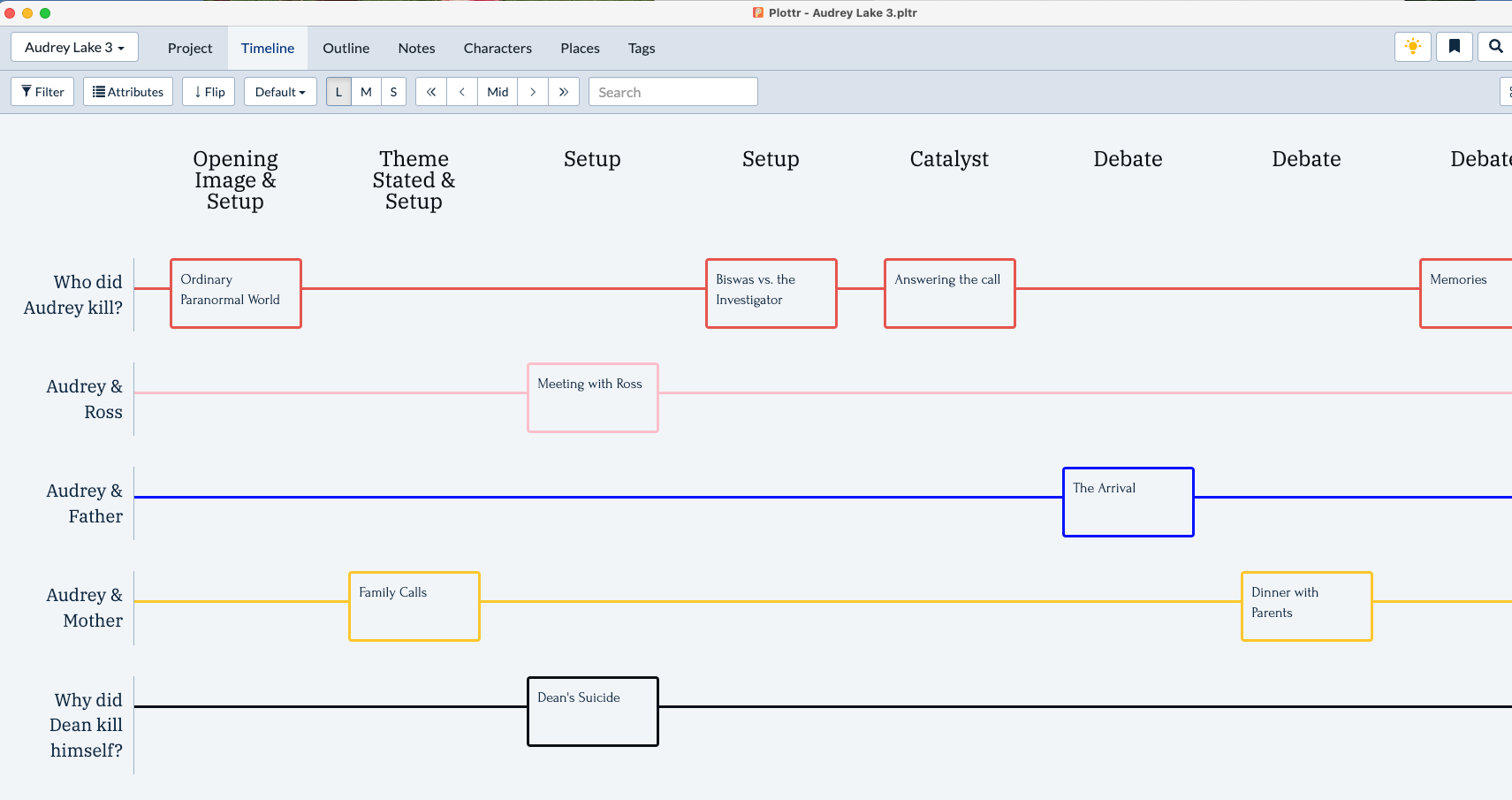
As of this writing, I have plotted out the most of the story. There’s still some holes in the third act and subplots, but I hope to get those closed before the end of the month.
I’m only using the surface level tools in Plottr. I’ve discovered there’s all kinds of templates for character development, scene development, and plot development, but since this is my first time with the tool (and plotting in general), I’m trying not to overwhelm myself.
Stay tuned to find out how it goes.
TOOL
The star of today’s episode is, of course, Plottr. I’ve decided I like this app. It has a nice visual interface, showing all the different plot lines and associated scenes/chapters. There’s the option of starting with a structural template, and the program has many to choose from, for all different genres. Disappointingly, it doesn’t have a Save the Cat template, which is what I use for these novels. But it isn’t hard to just plug in the necessary scene cards for those requirements or make your own template. I recommend this app for anyone who wants to plot their novel on a computer rather than cover their wall with notecards. You can either buy it outright or pay via subscription.
Affiliate link: plottr.com/?ref=nichelle
I really resonate with your process here. Love the magic of pantsing and when I finally followed an outline strategy from Elizabeth George I was able to write a rough draft in record time for me. While speed isn’t the point of this artistic process it is nice to actually finish a book! I’ve just started with Plottr and hope to use it for the next book.
It’s no secret that I thoroughly enjoy your Audrey Lake series. So glad you’re working on #3!
I’m somewhere between a plotter and a pantser, and I’ve been paying the price with a manuscript I’ve been working on for years. It’s the most complicated one I’ve attempted, and lately I’ve been thinking of paring it down to something more manageable. I might have purchased Plottr at some point, so I think I’ll either dig it up or buy it again, then work with the crazy thing I’ve created and try to make it into what I envisioned in the first place. Thanks for the nudge!